Learn to speak your real life.

Tell a short story about your life in English. Get it back in any of eleven languages, the way a native speaker would say it, and learn to say it from memory.

Try the beta on TestFlight

For iPhone. The App Store release is coming soon.

The Polyglot Method

Most apps have you tap, match and translate someone else’s sentences. Polyglots learn by saying their own life out loud, from memory, until it comes without thinking.

  • Your own life is the material.

    Who you are, where you live, what you did on Sunday. It’s easier to remember than a stranger’s sentences, and it’s what you’ll actually say.

  • Saying it from memory makes it stick.

    With only the English to go on, you pull each line from memory and say it out loud. That works far better than reading it again.

  • Stories come back before they fade.

    A story you haven’t said in a few days moves to the top of your list. Then you stretch it, two lines at a time.

One story, start to finish

A first story in Spanish, from the moment it’s told to the level it earns. Every story works this way, in all eleven languages.

  1. You tell it, in English.

    Hold the mic and talk the way you’d tell a friend: where you live, why you’re learning, how your week went.

  2. It comes back in Spanish.

    Four short lines, each with its English underneath. Tap any line to hear it in a natural voice.

  3. You say it from memory.

    Hold the mic and say a line with only the English to go on. Each word lights up as you say it.

  4. Say it all, and it earns its level.

    When you know every line, say the whole story with no help, and it’s stamped A1. Add two lines and say it all again to climb, all the way to C2.

From A1 to C2, one topic at a time

Each level is a set of topics to talk about, from saying hello to giving a toast. Tell a story for every topic in a level, grow your earlier stories to it, and the level is yours.

  1. A1

    A1: Getting to know you

    4 lines

    • Hi, I’m…
    • Where I’m from
    • My family
  2. A2

    A2: Everyday life

    6 lines

    • Last Sunday
    • What’s in my fridge
    • Booking a table
  3. B1

    B1: Stories and opinions

    8 lines

    • The best meal of my life
    • The time I got lost
    • City or countryside
  4. B2

    B2: Making your case

    10 lines

    • Phones at the table
    • Working from home
    • If I could live anywhere…
  5. C1

    C1: Thinking out loud

    12 lines

    • A moment that shaped me
    • Explaining my work to an outsider
    • A job interview
  6. C2

    C2: Saying it your way

    14 lines

    • The story I always tell
    • A word I can’t translate
    • Giving a toast

Real screens from the app

Every language has its own colour, its own stories and its own progress.

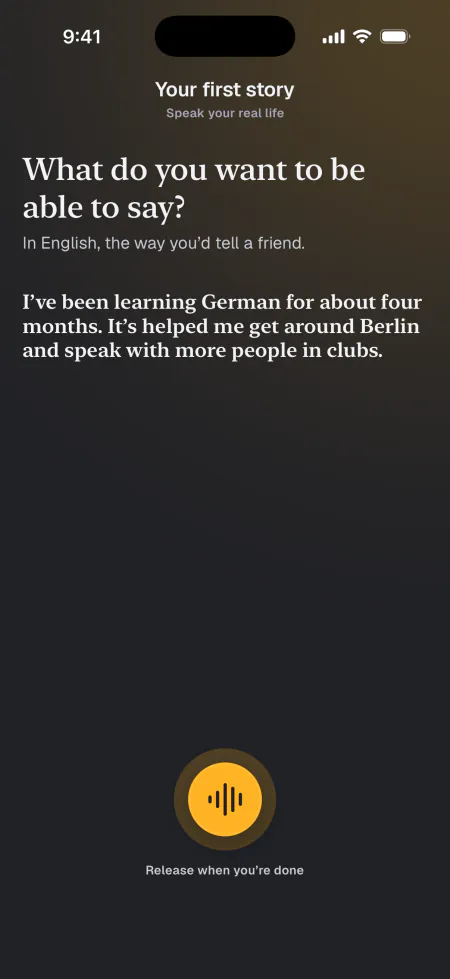
  • Telling a story in English with the mic held: “I’ve been learning German for about four months. It’s helped me get around Berlin and speak with more people in clubs.”

    German Telling a story

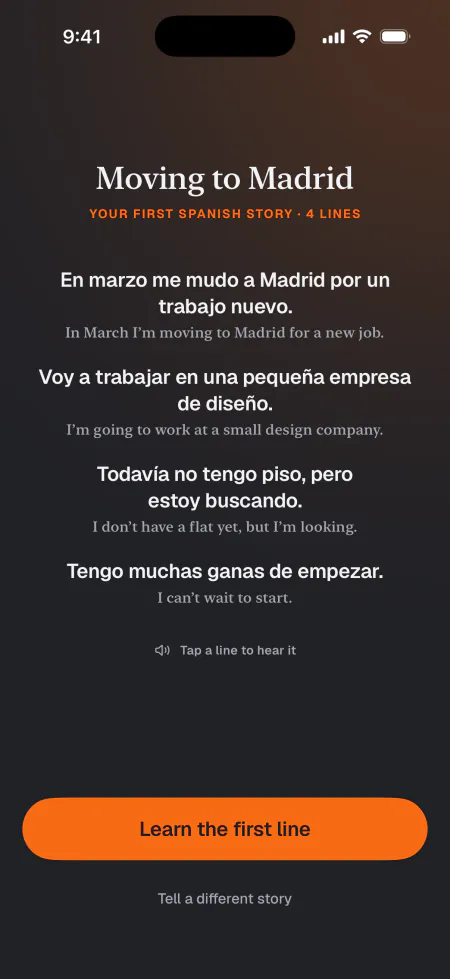
  • The story, written: Moving to Madrid, four short lines in Spanish, each with its English underneath, and a button to learn the first line.

    Spanish The story, written

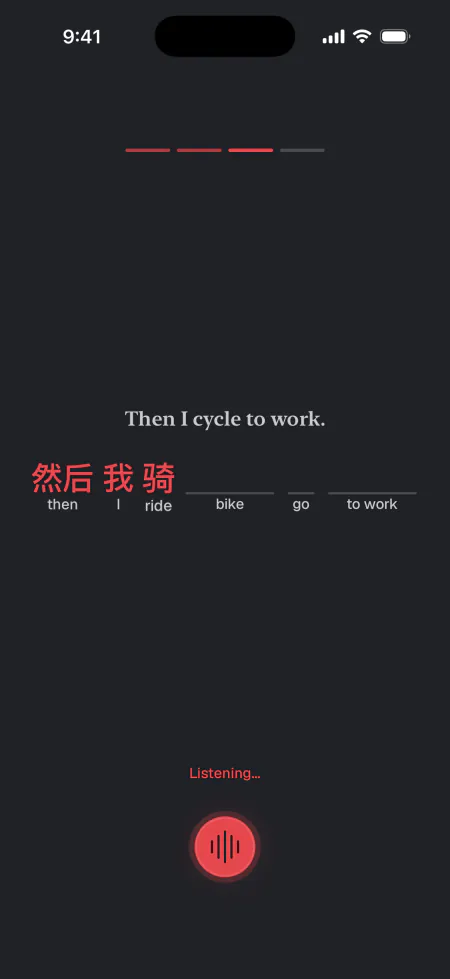
  • A line said from memory: the English cue, “Then I cycle to work,” and the Mandarin words lighting up as they are said, each over its English gloss.

    Mandarin A line, from memory

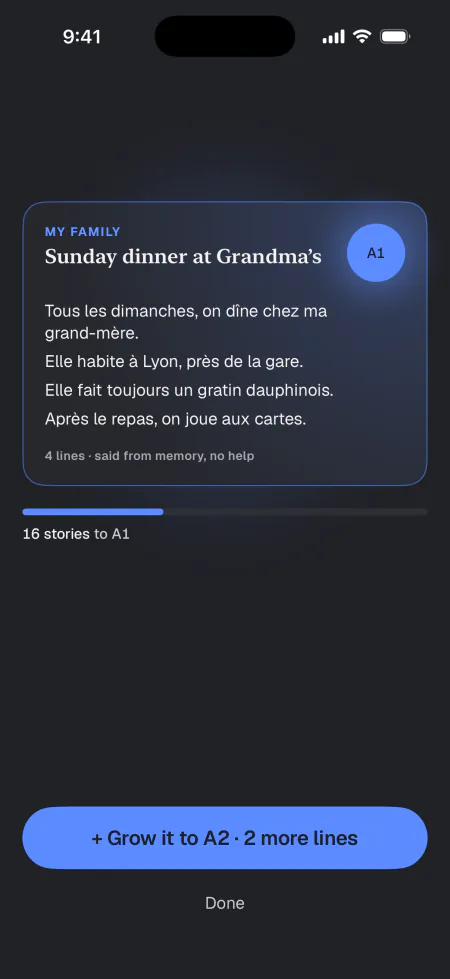
  • A level, earned: the story card Sunday dinner at Grandma’s, its four French lines said from memory with no help, stamped A1.

    French A level, earned

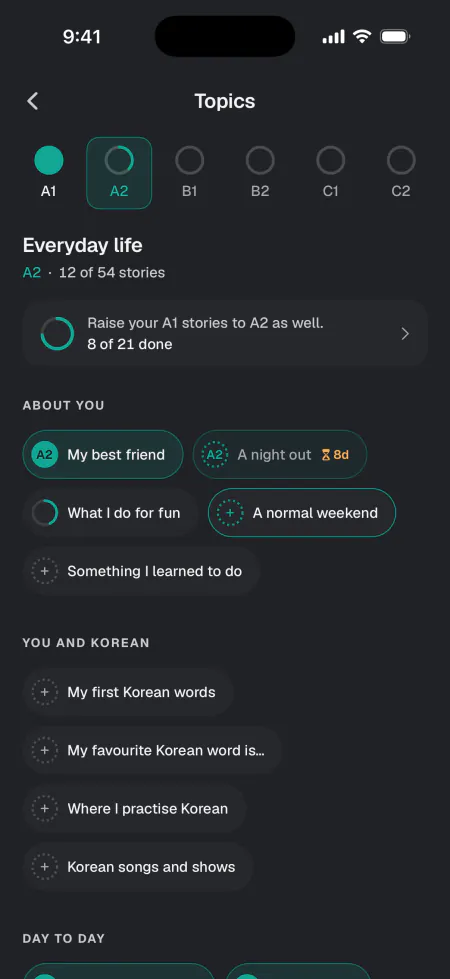
  • Topics for Korean: the levels A1 to C2 along the top, then things to talk about, like My best friend and A normal weekend, each with its story’s level.

    Korean Topics

A teacher on every line

Stuck on a line? Tap Hear it, and your teacher walks you through it out loud: each piece, what it means, and why it looks the way it does. Then one small swap to make it yours.

Your teacher speaks your language: English, Spanish, French, German, Italian, Portuguese, Dutch, Polish, Chinese, Japanese, Korean or Thai.

Quiero hablar con ella en Navidad.

I want to talk with her at Christmas.

Sofía, Mexico City · 0:20

What you hear, in English

“Quiero: ‘I want.’ Hablar: ‘to talk’; after quiero, the next verb stays in its basic form. Con ella: ‘with her.’ En Navidad: ‘at Christmas’; Spanish uses en here where English uses ‘at.’ You can change just the pronoun and say Quiero hablar con él to say you want to talk with him.”

Questions

Something else? Ask us.

Which languages can I learn?

German, French, Spanish, Italian, Portuguese, Dutch, Polish, Mandarin, Japanese, Korean and Arabic. Each keeps its own stories and progress, so you can learn more than one.

Can I choose an accent?

Yes. For each language you choose your teacher: a voice from a place, like Mexico City or Buenos Aires for Spanish, Paris or Montréal for French, Tokyo or Osaka for Japanese. Your stories stay in standard spelling, so what you learn works everywhere; only the voice you hear changes. You can change teacher any time.

Do I need to know any of the language first?

No. Your first stories are four short lines, and you hear every line before you say it. The first topics are the basics, like saying hello and where you’re from.

Do I have to speak out loud?

Yes, that’s the point. You tell your stories out loud and learn them by saying them. The mic only listens while you hold it.

What does it cost?

Your first story, and learning its first line, come before any plan. After that, Polyglot Pro is a weekly or yearly subscription through your Apple Account, with unlimited stories, every language and your teacher on every line. The yearly plan starts with a 7-day free trial for new subscribers. You’ll see the price in the app, in your currency, before you pay, and you can cancel any time in your App Store settings.

What happens to my stories?

They’re private to your account, never sold and never used for ads. Before anything you say goes to AI to be written into a story, the app tells you what is sent and asks. You can delete your account, with every story in it, from inside the app. Read the privacy policy.

How does it hear me?

Apple’s speech recognition turns what you say into words, which is how each word lights up as you say it. Arabic is the one exception, and only on an iPhone that can’t recognise it: then your recording goes to our server to be turned into text when you let go. Polyglot Pro doesn’t keep it.

Are the stories written by AI?

Yes. AI writes your story from what you said, and the voices you hear are made with AI too. AI can make mistakes, so if a line looks wrong, let us know.

Is there an Android or web version?

No. Polyglot Pro is made for iPhone.

What do you want to be able to say?

Answer in English, about your own life, and learn to say it in the language you’re learning.

Try the beta on TestFlight

For iPhone. The App Store release is coming soon.